

Consumer products behemoth Procter & Gamble (NYSE:PG) announced better-than-expected revenue in calendar Q3 2026 (fiscal Q1 2027), with sales up 4% year on year to $23.28 billion. Its non-GAAP profit of $2 per share was 5.7% above analysts’ consensus estimates.
Is now the time to buy Procter & Gamble? Find out by accessing our full research report, it’s free.
Procter & Gamble (PG) Q3 CY2026 highlights:
- Revenue: $23.28 billion vs analyst estimates of $22.82 billion (4% year-on-year growth, 2% beat)
- Adjusted EPS: $2 vs analyst estimates of $1.89 (5.7% beat)
- Management reiterated its full-year Adjusted EPS guidance of $7 at the midpoint
- Operating Margin: 25.5%, down from 26.2% in the same quarter last year
- Free Cash Flow Margin: 18.9%, up from 18.0% in the same quarter last year
- Market Capitalization: $364.3 billion
“Our solid sales, earnings and cash results in the first quarter reflect sharpened execution of our integrated strategy,” said Shailesh Jejurikar, Chairman of the Board, President and Chief Executive Officer. “While we expect there will continue to be geopolitical and economic challenges, this strong start keeps us on track to deliver within our guidance ranges for organic sales growth, core EPS growth and free cash flow productivity for the fiscal year. We remain committed to our strategy to delight consumers with superior products at a superior value by putting the consumer first in everything we do. We are confident in the near term and excited about the future.”
Company overview
Founded by candle maker William Procter and soap maker James Gamble, Procter & Gamble (NYSE:PG) is a consumer products behemoth whose product portfolio spans everything from facial tissues to laundry detergent to feminine care to men’s grooming.
Revenue growth
A company’s long-term sales performance can indicate its overall quality. Any business can put up a good quarter or two, but many enduring ones grow for years.
With $87.92 billion in revenue over the past 12 months, Procter & Gamble is one of the most widely recognized consumer staples companies. Its influence over consumers gives it negotiating leverage with distributors, enabling it to pick and choose where it sells its products (a luxury many don’t have). However, its scale is a double-edged sword because it’s harder to find incremental growth when your existing brands have penetrated most of the market. To expand meaningfully, Procter & Gamble likely needs to tweak its prices, innovate with new products, or enter new markets.
As you can see below, Procter & Gamble’s 1.8% annualized revenue growth over the last three years was sluggish, but to its credit, consumers bought more of its products.
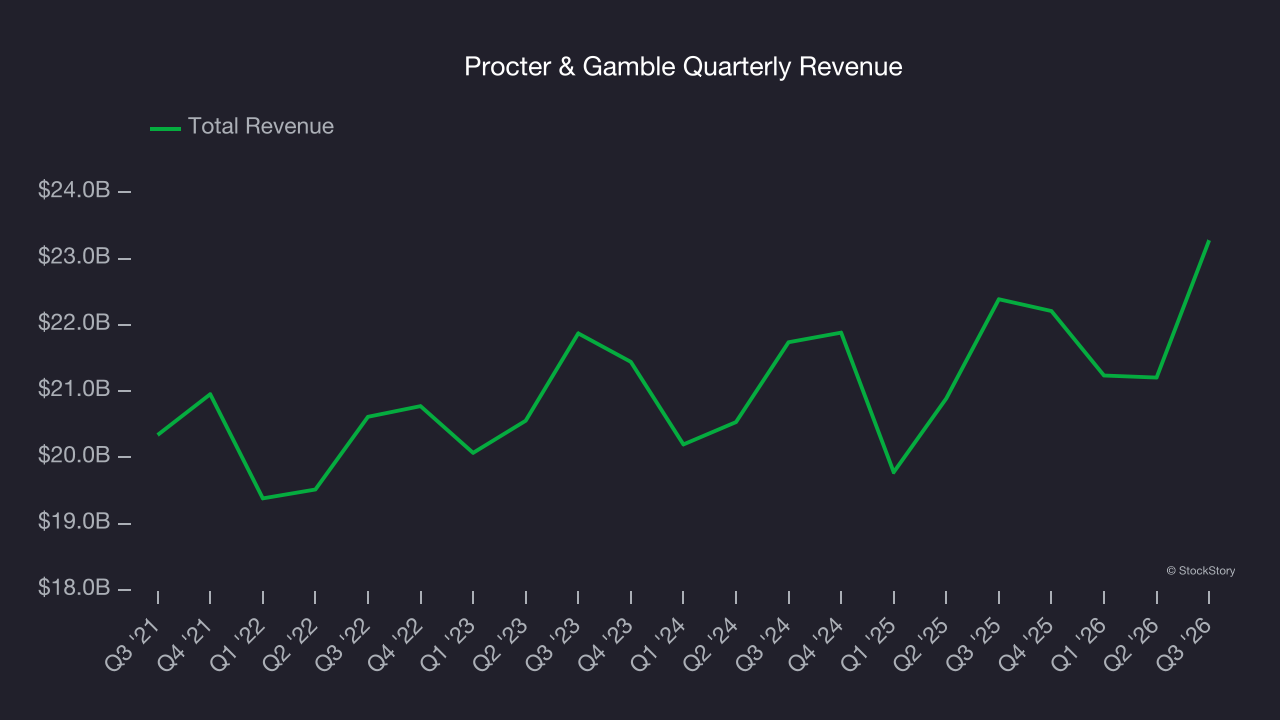
This quarter, Procter & Gamble reported modest year-on-year revenue growth of 4% but beat Wall Street’s estimates by 2%.
Looking ahead, sell-side analysts expect revenue to grow 2% over the next 12 months, similar to its three-year rate. This projection doesn’t excite us and indicates its newer products will not accelerate its top-line performance yet.
WHILE YOU’RE HERE: The Next Palantir? One satellite company captures images of every point on Earth. Every single day. The Pentagon wants it. Hedge funds are using it to beat earnings. You’ve probably never heard of it.
This is what the early days of Palantir looked like before it became a giant. Same playbook. Different technology. If you missed Palantir, you need to see this. Claim The Stock Ticker for Free HERE.
Cash is king
Although earnings are undoubtedly valuable for assessing company performance, we believe cash is king because you can’t use accounting profits to pay the bills.
Procter & Gamble has shown terrific cash profitability, driven by its lucrative business model that enables it to reinvest, return capital to investors, and stay ahead of the competition. The company’s free cash flow margin was among the best in the consumer staples sector, averaging 17.9% over the last two years.
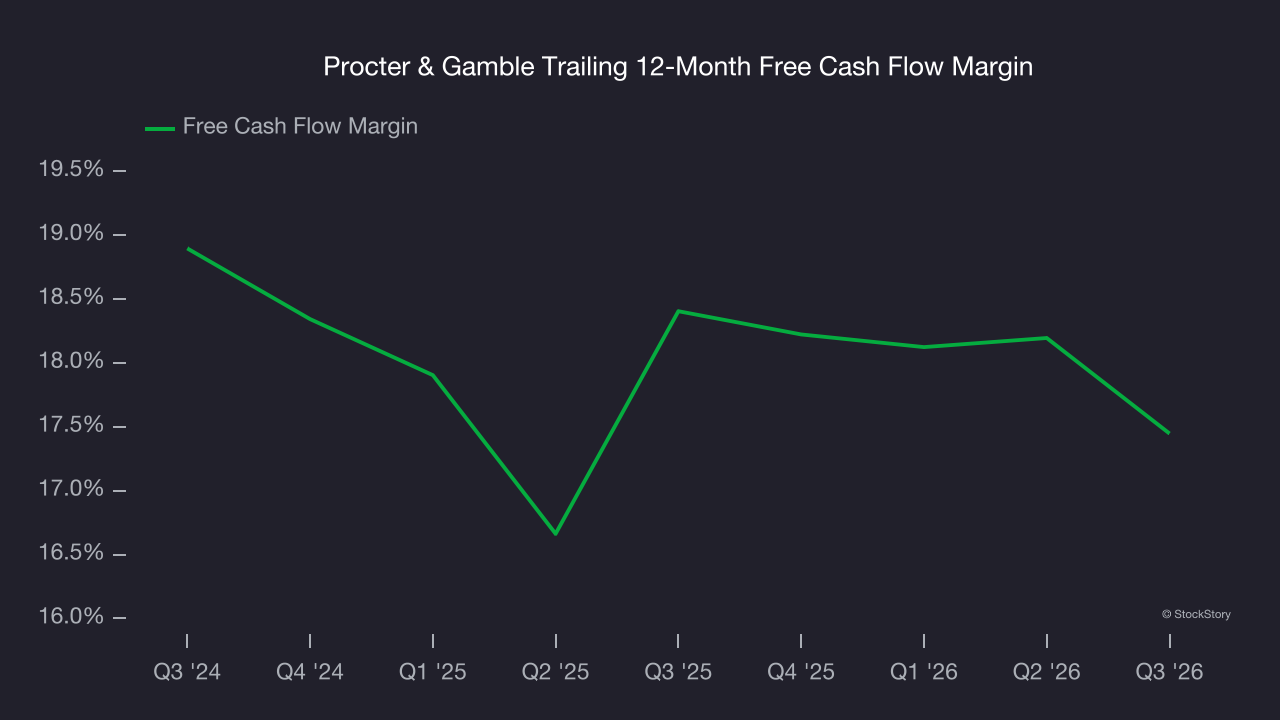
Procter & Gamble’s free cash flow clocked in at $4.40 billion in Q3, equivalent to a 18.9% margin. The company’s cash profitability regressed as it was 3 percentage points lower than in the same quarter last year. This warrants extra attention because consumer staples companies typically produce more consistent and defensive performance.
Key takeaways from Procter & Gamble’s Q3 results
It was encouraging to see Procter & Gamble beat analysts’ revenue expectations this quarter. We were also glad its EPS outperformed Wall Street’s estimates. Overall, this print had some key positives. The stock traded up 1.9% to $159.95 immediately following the results.
Big picture, is Procter & Gamble a buy here and now? If you’re making that decision, you should consider the bigger picture of valuation, business qualities, as well as the latest earnings. We cover that in our actionable full research report which you can read here (it’s free).