

Pool products retailer Leslie’s (NASDAQ:LESL) reported Q3 CY2025 results topping the market’s revenue expectations, but sales fell by 2.2% year on year to $389.2 million. On the other hand, the company’s full-year revenue guidance of $1.18 billion at the midpoint came in 4.4% below analysts’ estimates. Its non-GAAP profit of $0.09 per share was 93.1% below analysts’ consensus estimates.
Is now the time to buy Leslie's? Find out by accessing our full research report, it’s free for active Edge members.
Leslie's (LESL) Q3 CY2025 Highlights:
- Revenue: $389.2 million vs analyst estimates of $373.5 million (2.2% year-on-year decline, 4.2% beat)
- Adjusted EPS: $0.09 vs analyst expectations of $1.30 (93.1% miss)
- Adjusted EBITDA: $45.16 million vs analyst estimates of $39.36 million (11.6% margin, 14.8% beat)
- EBITDA guidance for the upcoming financial year 2026 is $65 million at the midpoint, below analyst estimates of $74.97 million
- Operating Margin: -38.6%, down from 6.6% in the same quarter last year
- Free Cash Flow Margin: 10.7%, up from 8.6% in the same quarter last year
- Locations: 1,000 at quarter end, down from 1,021 in the same quarter last year
- Same-Store Sales fell 6.5% year on year (-8.3% in the same quarter last year)
- Market Capitalization: $27.4 million
“We delivered fourth quarter sales and adjusted EBITDA above the high end of our previously established guidance range and are today announcing the closure of 80-90 underperforming stores and one distribution center as we work with speed and urgency to improve Leslie's operations and establish a clear path to financial recovery,” said Jason McDonell, Chief Executive Officer of Leslie’s.
Company Overview
Named after founder Philip Leslie, who established the company in 1963, Leslie’s (NASDAQ:LESL) is a retailer that sells pool and spa supplies, equipment, and maintenance services.
Revenue Growth
A company’s long-term performance is an indicator of its overall quality. Any business can have short-term success, but a top-tier one grows for years.
With $1.24 billion in revenue over the past 12 months, Leslie's is a small retailer, which sometimes brings disadvantages compared to larger competitors benefiting from economies of scale and negotiating leverage with suppliers.
As you can see below, Leslie’s demand was weak over the last three years (we compare to 2019 to normalize for COVID-19 impacts). Its sales fell by 7.4% annually as it didn’t open many new stores and observed lower sales at existing, established locations.
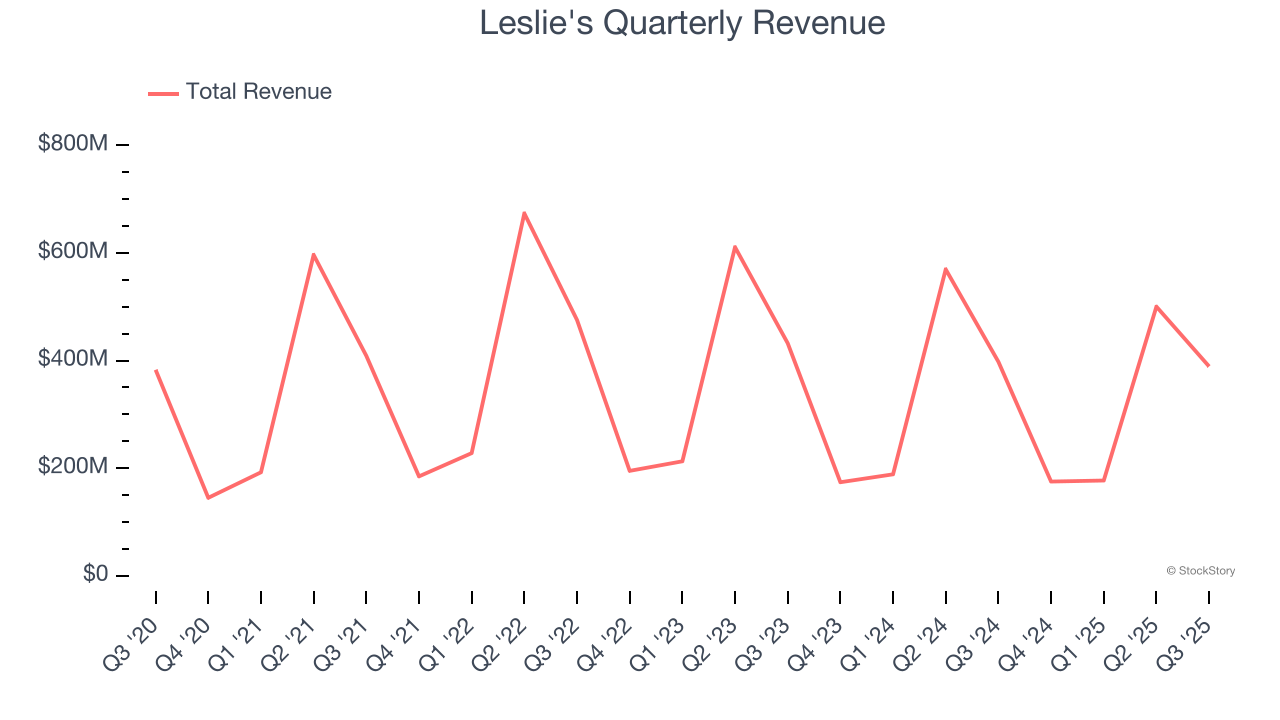
This quarter, Leslie’s revenue fell by 2.2% year on year to $389.2 million but beat Wall Street’s estimates by 4.2%.
Looking ahead, sell-side analysts expect revenue to remain flat over the next 12 months. While this projection suggests its newer products will fuel better top-line performance, it is still below the sector average.
The 1999 book Gorilla Game predicted Microsoft and Apple would dominate tech before it happened. Its thesis? Identify the platform winners early. Today, enterprise software companies embedding generative AI are becoming the new gorillas. a profitable, fast-growing enterprise software stock that is already riding the automation wave and looking to catch the generative AI next.
Store Performance
Number of Stores
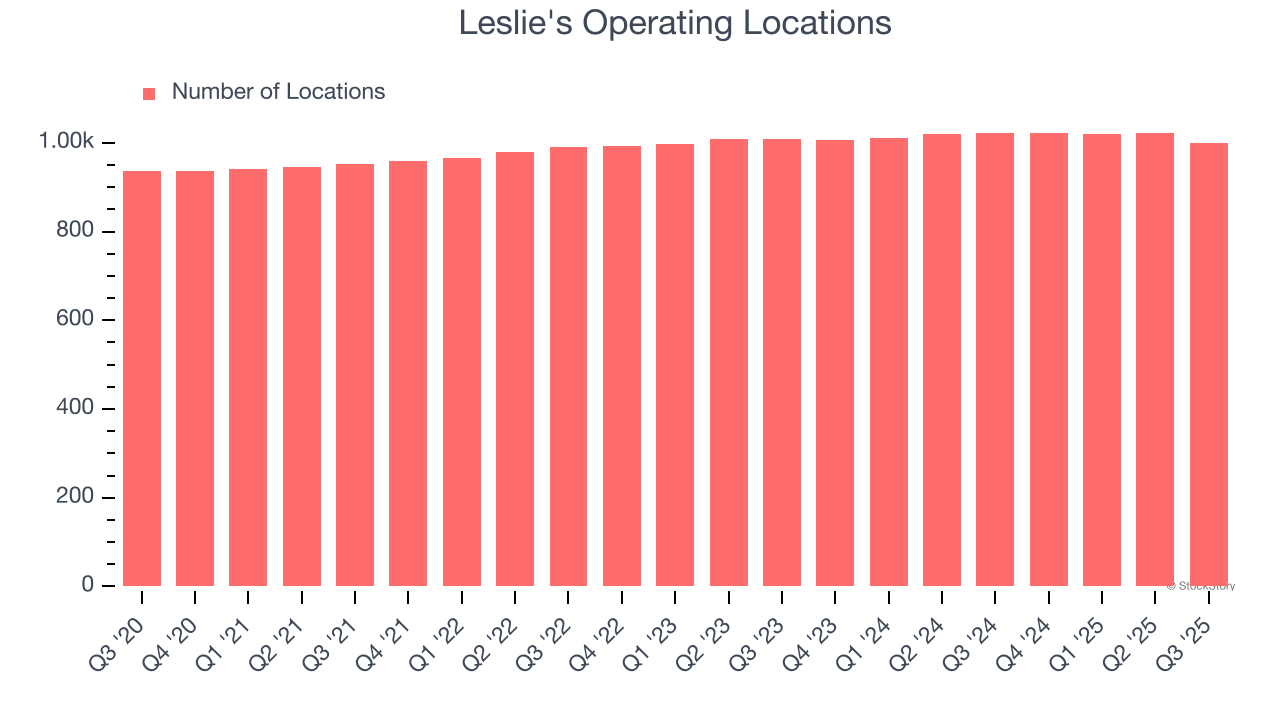
Leslie's operated 1,000 locations in the latest quarter, and over the last two years, has kept its store count flat while other consumer retail businesses have opted for growth.
When a retailer keeps its store footprint steady, it usually means demand is stable and it’s focusing on operational efficiency to increase profitability.
Same-Store Sales
A company's store base only paints one part of the picture. When demand is high, it makes sense to open more. But when demand is low, it’s prudent to close some locations and use the money in other ways. Same-store sales provides a deeper understanding of this issue because it measures organic growth at brick-and-mortar shops for at least a year.
Leslie’s demand has been shrinking over the last two years as its same-store sales have averaged 8.1% annual declines. This performance isn’t ideal, and we’d be concerned if Leslie's starts opening new stores to artificially boost revenue growth.
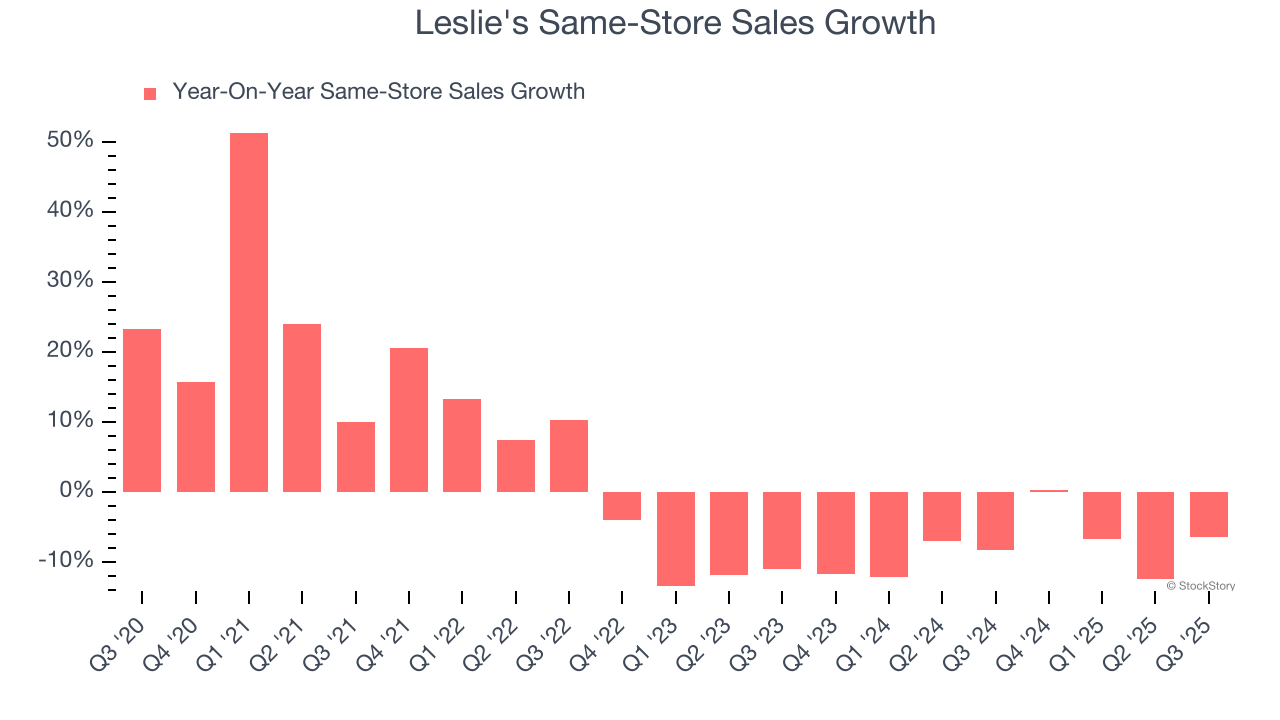
In the latest quarter, Leslie’s same-store sales fell by 6.5% year on year. This decrease represents a further deceleration from its historical levels. We hope the business can get back on track.
Key Takeaways from Leslie’s Q3 Results
We were impressed by how significantly Leslie's blew past analysts’ EBITDA expectations this quarter. We were also excited its revenue outperformed Wall Street’s estimates by a wide margin. On the other hand, its full-year EBITDA guidance missed and its EPS fell short of Wall Street’s estimates. Overall, this was a softer quarter. The stock traded down 14.5% to $3.05 immediately following the results.
Leslie's didn’t show it’s best hand this quarter, but does that create an opportunity to buy the stock right now? If you’re making that decision, you should consider the bigger picture of valuation, business qualities, as well as the latest earnings. We cover that in our actionable full research report which you can read here, it’s free for active Edge members.